From The Holocaust To My Favorite Murder: MONSTER: THE ED GEIN STORY Tracks The Ghoulish Trail Of The Macabre In Our Culture

Abandon all hope of realism and factuality, ye who watch Monster: The Ed Gein Story. This eight part Netflix series is not all that interested in what really happened in Wisconsin back in the 1940s and 50s but rather how what happened shaped the culture in which we live today. The show does have some factual elements, sure, but fidelity to small t truth isn’t what writer/occasional director Ian Brennan (and co-director Max Winkler) is interested in. He’s looking to get at the big T Truth, the larger shared reality that has informed the zeitgeist since the moment Gein was captured, without incident, by the police.
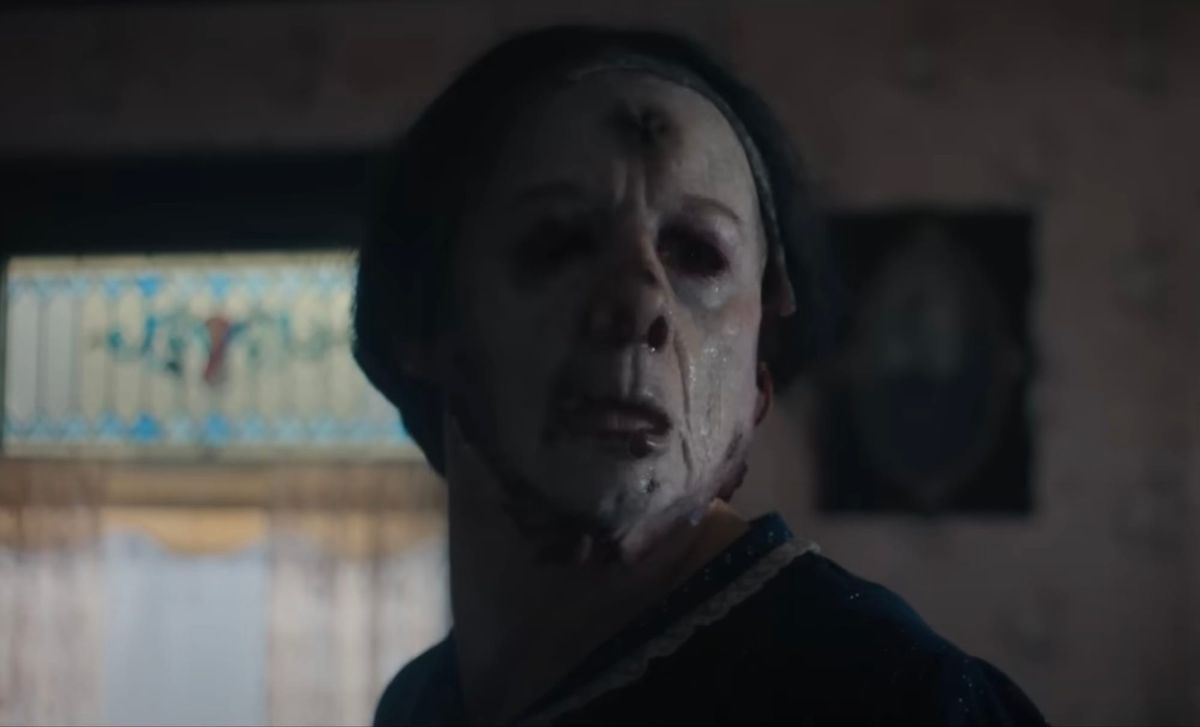
For those who don’t know the true story of Ed Gein, the show gives you the basics. A strange man who was obsessed with his mother, Gein became a real life ghoul, digging up corpses from local cemeteries and using them to make furniture, decorations and a female fleshsuit. He also committed murders - two of which are certain, because the victims’ body parts, including a woman’s carcass hung up and gutted like a deer, were found in his home. There are other murders and disappearances that have been speculatively connected to Gein, but he always denied his involvement and even passed lie detector tests on the subject.
As soon as the story hit the newspapers and became an international sensation Ed Gein passed from being a person into being a legend, a real life boogeyman. As if his crimes were not grotesque enough they were exaggerated in retelling - a heart was found boiling on his stove, he had sex with the corpses, he killed children - and in many ways these myths became the larger cultural truth of Gein. Monster: The Ed Gein Story is very much about that, is very much about examining the space between reality and fiction and especially about looking at how Gein and his crimes informed horror films, the appetite for true crime and the actions of future serial killers (I believe Gein committed three murders in total, which technically makes him a serial killer, but I don’t think he truly fits that category. And in the show neither does Ed Gein). The series draws a straight line from Nazi concentration camps to Silence of the Lambs, and honestly I think this is not a stretch at all.
In many ways Monster: The Ed Gein Story is a “print the legend” situation, but that applies to most dramatized true crime stories. What makes this different is that the show is heightened in an extreme way that should let viewers know that what they’re watching is not terribly interested in accuracy (this has not stopped a number of people from complaining about Monster’s willful lack of accuracy). There is a sequence in which Gein hallucinates himself as Norman Bates in the Psycho shower scene, a sequence that takes place years before Psycho - which was itself inspired by Gein’s crimes - was even made. That’s the vibe here, a playful and strange romp through the strands that extend out from Gein’s crimes into our present moment.
The show is also campy as hell. That’s maybe something else that people missed when the series premiered; yes, it’s a beautifully shot show (one of the cinematographers shot One Battle After Another!) and yes it has slow moments that are intended to build tension (and also, this being Netflix, give you a chance to look at your phone) but these slower stretches are punctuated by absolutely over the top looniness, and the whole thing has a slyly dry sense of humor. Tongue is planted firmly in cheek, even as it may also be nailed to a wall in Gein’s home.
To me the tonal variation worked spectacularly; the jokes would emerge like little lit up fireflies from the fetid swamp of the true story, and every time they would hit me twice as hard than if they had been more obvious. This is the kind of show towards which some people will condescend, saying that it doesn’t know when it’s being funny or silly, but I can’t agree. One of the final scenes of the series is an homage to musical death dream in All That Jazz, scored to a Yes song. You simply do not put that in your true crime show unless you’re fully aware of what you’re doing.
In that spirit Brennan is fully aware of what he’s getting wrong, factually. I’ve read some interviews with him and he absolutely knows that he has created incredibly fictional situations within the life of Gein. Brennan knows that the babysitter murder presented in his series didn’t happen like that, and that Gein was certainly not involved in it. He knows that Gein didn’t give the FBI insight that helped them catch Ted Bundy. And he definitely knows that the show’s depiction of a woman named Adeline Watkins as an accomplice of Gein’s is beyond fantasy. So beyond fantasy that he makes up a whole series of events where she goes to New York City, meets crime photographer Weegee and murders a woman. Bunk, nonsense, all of it. But nonsense that helps Brennan with the themes he’s exploring.
Let’s talk about Watkins a bit. In reality Adeline Watkins was a 50-something year old spinster who, as soon as Gein was arrested, said that she had been his sweetheart for twenty years and that he was a sweet and nice man. Or maybe she didn’t - Watkins’ story made headlines across the globe and she quickly insisted that none of those things were true, that she had only been an acquaintance of Gein’s. What’s the truth? Did the story-hungry press that descended upon Plainfield, Wisconsin to cover Gein put words in her mouth? Or did this lonely woman make up the tale to get attention and then discovered she didn’t like that attention after all? (She definitely was not Gein’s sweetheart, whatever the case)
Brennan takes a third path - she really was Gein’s sweetheart, she really was on his morbid wavelength, but when he got arrested she, like Peter with Jesus, denied knowing him. This allows Brennan to have Watkins serve three purposes - one, she’s a character who can be in Gein’s life which was otherwise quite solitary, and who he can share his thoughts with. Two, she represents the world of true crime fans, as she is one herself, and gives the show the space to critique its own audience. And three she personally represents the townsfolk that went from thinking Gein was a harmless simpleton one day to telling tales about how he had almost killed them one time the next (these stories were all exaggerations). Monster’s version of Watkins is a cosmic departure from reality, but in many ways this is how drama works. We don’t look at Shakespeare’s historical plays and critique them for getting facts, dates or personalities wrong. He was taking true stories and using them to get at his interests, to create the drama he wanted to create.*
*Worth noting that just as it is today, this was controversial in his time! Take the character of Falstaf from Henry IV and Merry Wives of Windsor; there’s a lot of evidence that this comic relief character was originally named Oldcastle, a real guy who was a martyr. Oldcastle’s descendants had enough power in Shakespeare’s time that the Bard seems to have decided it was better to simply change the name and avoid any trouble.
That betrayal by Watkins feeds the show’s oddest decision - it makes Ed Gein very, very sympathetic. I do think Gein is a fascinating character because he’s so fundamentally unlike the killers and weirdos who came after him; he was undeniably mentally ill to the extreme, and the two murders we know he committed (I’m personally certain he killed his older brother, which the show dramatizes, but it’s never been officially confirmed) seem to have occurred while he was in some kind of a dazed, disassociated state. He was a sad, lonely freak who mostly robbed graves - which, you know, ain’t great - but he was no Richard Speck, who does turn up in this show.
This is why Norman Bates has always been the best fictionalized Gein; while Psycho very much diverges from the truth of the case the deep sad insanity at the heart of Anthony Perkins’ performance does reflect what seems to have been going on with Gein. Perkins and Alfred Hitchcock show up in Monster: The Ed Gein Story, and the actor’s role is really interesting. Perkins takes the job over the objections of his boyfriend, teen heartthrob Tab Hunter, and he finds Gein’s monstrosity reflected in his feelings towards his own homosexuality. There’s some really nutty stuff in the Psycho sections of the series, including Perkins kind of traveling back in time (psychologically) and seeing Ed Gein at work, but that just adds to the fun.
Perkins’ homosexuality is one of the ways that the show engages with gender and sexuality, and many folks have found its approach to be transphobic. This is a thorny subject, and before we go any further I want to clarify that I’m a cis male and so I’m only doing intellectual analysis here. I have no lived experience as a trans person and, as such, I am not going to be arguing with trans folks about how they feel Monster handles trans issues. What I’m analyzing is what I believe the show is trying to do; whether or not it succeeds is up to the individual viewer.
Trans issues are impossible to avoid when talking about Ed Gein, who sewed himself a flesh suit from the corpses of women. The three major horror films that were inspired by Gein - Psycho, The Texas Chain Saw Massacre and Silence of the Lambs* - each touch on this aspect of the Gein story, with Silence of the Lambs’ Buffalo Bill being the most clearly trans of the three killer characters. Norman Bates isn’t really trans, he’s taking on the persona of his mother. Leatherface is not trans either, but he definitely exists in his own space on the gender spectrum. He applies make-up to his mask and he does traditionally female things within the Sawyer family, but it seems pretty clear Leatherface isn’t trying to become a woman, he’s simply expressing feminine parts of himself. Buffalo Bill, though, wants to be a woman. It seems to me that he wants to be a woman in a fetishistic way, not in a gender expressive way, but that’s a debate for another time. At any rate, “cross dressing” is a key feature of the Gein case and of his cinematic offspring.
*It seems to me that Pieces, with its chainsaw kills and a guy building a woman out of body parts, is indebted to Gein as well, and Monster seems to think so too - there’s a shower kill (not the Psycho one) that feels a lot like it’s homaging a similar kill in Pieces.
Ed Gein was almost certainly not trans. Likely he wasn’t even a crossdresser. He was probably closer to Bates in that he wanted to be his mother (the show accurately depicts that Gein couldn’t dig his own mom up because she was interred with a concrete seal, so he had to find other women) but that doesn’t stop the show from giving us a few scenes of him jerking off or having sex while wearing a bra and panties. This is where it gets complicated and where maybe the show doesn’t make itself as clear as it could, consider it’s on Netflix and most of the viewers will be deeply second screening the whole time they watch. I think what Monster is doing here is incorporating the cultural legend of Gein into its portrayal of him, much as it shows him committing necrophilia, which he never did (he said the corpses smelled too bad). Just as Brennan has reality and Gein’s hallucinations co-exist, so he has the real and the mythical Gein co-exist.
What he tries to do to mitigate this is have a scene towards the end where Gein is told by trans pioneer Christine Jorgensen that he is not trans. Yes, it’s weird. He also talks to Ilse Koch, the Bitch of Buchenwald, foundation for the lead character in Ilsa: She-Wolf of the SS. In the conversation with Jorgensen (via ham radio) she explains to him that he’s actually nothing like her, and that he’s kind of got some weird issues not with wanting to be a woman but wanting to completely exist within them. The way this plays out is that we learn the conversation is a hallucination that has Gein, playing both himself and Jorgensen, express his understanding that he’s not trans. Does this work? Not according to many people. I saw what the show was doing, but I do think audiences do not tune into true crime dramatizations for subtlety. This needed to be made more explicit earlier in the series, instead of waiting for the penultimate episode.
The gender and sexuality stuff gets thornier, I believe, when Richard Speck shows up. Speck was a mass murderer who killed eight student nurses in one gore-soaked night, and he ended up in prison. While in prison Speck began taking female hormones to grow breasts and wore a bra and panties while having sex with other inmates. It’s certain that Speck was also not trans, but that rather he was feminizing himself for sexual purposes; this was a huge scandal when video of him sucking off another inmate went public, in which he said, "If they only knew how much fun I was having, they'd turn me loose."
Speck is presented as an Ed Gein admirer who sends the Ghoul of Plainfield fan letters. This never happened, and I have never come across a source that showed Speck had any interest in Gein whatsoever, but Brennan is again fictionalizing reality to serve his thematic purposes. In Monster Gein finds many of the killers who came after him - who are portrayed in the show as big fans, including Charles Manson - sick and disgusting. The show has Gein help the FBI capture Ted Bundy not only for the Silence of the Lambs reference but also so that we know he’s actually a sweet guy who isn’t like these psychopaths (as I said earlier, Monster really finds itself charmed by Gein at the end. The final shot of the series is Ed Gein in heaven!). My assumption is that the inclusion of Speck is a way of distancing Gein from other gender oddness - he’s not a strange pervert like this guy. This stuff, I think, lands even less than the trans/Jorgensen stuff does, and the late appearance of Speck - who consistently has his tits out - muddies the thematic waters.
Which is too bad because I think the themes of this show are top notch and raise questions in a way with which I wish more of the audience engaged. In both real life and the show Gein is profoundly changed by the Holocaust and the atrocities committed by Ilse Koch, who turned Jewish prisoners into lamps. Gein became obsessed with the Nazi horrors, but not in an ideological way, rather in the same way that true crime fans become obsessed with the bizarre cases that haunt their dreams. Gein is a general true crime fan himself (in real life at least one crusader used the Gein case as a reason why comic books and pulp magazines were evil), and since he was young was interested in the macabre, like stories of head hunters and cannibals. These things likely resonated for Brennan as they did for me; growing up a kid with dark interests was an isolating thing, and it wasn’t like I chose to be really into serial killers or strange deaths, it was just something going on in my brain. On some level anyone who sits down to watch eight hours about a guy who murdered women and dug up dead bodies has that same darkness within themselves.
Monster’s thesis is that while these traits have been with us forever, the Holocaust fundamentally shifted our relationship with the grisly and morbid side of life. What had been kept in the pages of lurid pulps and gleefully gross comic books exploded into the larger consciousness, and Ed Gein represents the barrel through which this psychic bullet was fired. When Psycho came out the violence - quaint by today’s standards - was unprecedented but by the time Monster: The Ed Gein Story came into the living rooms of people everywhere no one was phased by chainsaws ripping flesh or intestines wrapped up in clothes and dropped on the floor. Your grandmother watches this stuff, and it was the media sensation of Gein that fed into movies that expanded our relationship with the sickest, creepiest stuff. It was also a huge boost for true crime, and the show argues that Gein was ground zero for the wave of American serial killers that followed him*. Monster traces the thread from the Holocaust to the modern day - in one of the show’s Return of the King-reminiscent multiple endings a modern young kid is menaced in a graveyard by Gein’s cinematic children, representing the way that he still frightens and confronts us almost a century later - and it asks us to look at our own interest in these things. What makes us want to sit down and watch these things, what makes true crime so huge in the podcast and streaming world? There is no answer, no pat solution, just the question which is asked in a provocative and entertaining way. Yet it’s a question that maybe the people who most need to ponder it will never recognize in the program.
*I find this convincing, but in a weird way. I don’t think that Gein inspired the rest of these guys so much as something about Gein and his crimes shifted the possibilities of what could happen in a metaphysical way. Like he blew open the doors of reality and let in a torrent of evil. I know, it’s hippie dippie.
But even when Monster: The Ed Gein Story isn’t quite hitting the way it needs to in order to service its ideas and themes, it has those ideas and themes. And I think the big swings, especially in terms of camp and surreality, make the show a truly thrilling watch for folks willing to engage with it on levels beyond mindless background noise. It’s exploitative yet thoughtful, a combination that we see too rarely and one that produces not just the kind of fun viewing experience where you will burst out laughing at an unexpected piece of insanity (like when Tobe Hooper, director of The Texas Chain Saw Massacre, uses a chainsaw to massacre people in line ahead of him at a department store) but also where you find the themes lingering with you days after you’ve finished watching. Streaming is the home of utterly forgettable fluff, but Monster: The Ed Gein Story has been hanging around in my mind, like a fleshsuit that constantly beckons me to put it on one more time.