The 129th Los Angeles County Burial of the Unclaimed Dead

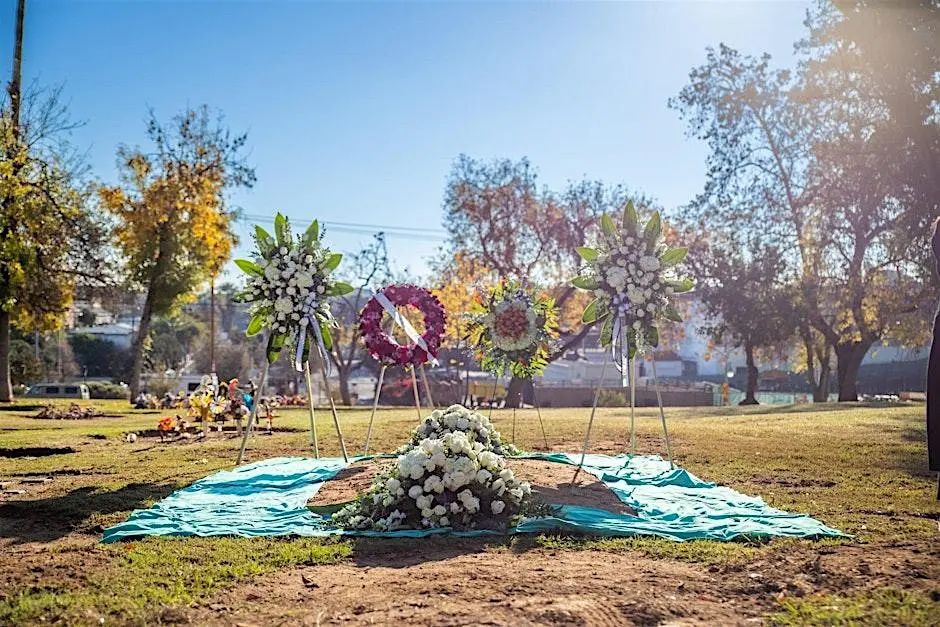
Since 1896 Los Angeles County has made a promise to the people here: no matter who you are, no matter what your circumstances, you deserve and will be given a proper burial. Every year the county buries the unclaimed dead, people who died within the county but - for one reason or another - had no one come and take them, people who were seemingly alone in the world. They are not just dumped into a potter’s field but rather given a real interfaith ceremony, attended by people from the community who know how it important it is to bear witness to our shared and immutable humanity.
This year’s burial was for the 2,308 unclaimed people who died in 2022. The county spends three years trying to find anyone related to or connected to the dead, and when they cannot, their remains are interred. The bodies are cremated, and what is buried are the cremains, each in their own container. This year the number of those buried was higher than normal - higher than it has been in almost half a century - likely because of COVID and the ways it disrupted life and relations for people.
Who was buried? Certainly addicts and the homeless. Sex workers and the mentally ill. Immigrants and foreigners. The elderly who outlived everyone they knew. People who had no one and who came to Los Angeles to start a new life. This year there were children among the number of unclaimed dead, an idea that is almost unthinkable to me. Whatever their circumstance, each of these two thousand, three hundred and eight people were human beings, and for all they suffered they also loved and laughed and danced and had ideas and hopes. They each embodied the full range of human experience. They were all people.
The ceremony happened on a beautiful, sunny day. The last time I attended this service it was rainy and the whole cemetery was a mud pit, but this year it was 80 degrees with the clearest sky you could hope for, the pale and distant Moon visible even at 10AM. There was gorgeous choral singing, and faith leaders gave prayers in their own tradition. The Lord’s Prayer was recited in five different languages, speaking to the diversity of the people of Los Angeles. A Buddhist monk chanted hypnotically while ringing a bell. There was a beautiful Native American sage ceremony. A rabbi sang his prayers in a melodious voice that took me by surprise.
About a hundred people attended the funeral, and at the end we were each given a single white rose to lay on the gravesite, a way for us to directly honor those buried that day and reaffirm that, no matter how much it seemed otherwise, they were not forgotten. To say that this was moving would be to undersell every aspect of it, and what made the event so unusual in this particular city was how clearly this was not a place to be seen, how clearly everyone who attended was there for the purpose of honoring their fellow Angelenos and human beings. There was press but there was not an influencer. Nothing seemed performative; every single person was there with solemnity and respect.
It’s possible - certain, actually - that some of the people who were buried that day were, in the modern parlance, problematic. It’s a guarantee that people buried that day had harmed others, had caused anguish, had ideas and beliefs that were ugly and unpleasant. I know that to be true because they were people, and every person has harmed someone, has caused someone anguish, has at one time or another held ugly beliefs and thoughts. That’s part of being a human being, which is why those elements do not make these unclaimed people less human but just as human as the rest of us. We live in a moment in social history where who gets to be a person is decided along a number of awful lines - some of them racist, sexist, homo and transphobic, and some of them predicated on the idea that certain folks lose their right to personhood when they transgress or hurt others. This week the comedian and actor Andy Dick had an overdose on a Los Angeles city street. Dick is a real problem person, someone who has been a jerk, an assaulter, and may have facilitated a murder. Not a great record. I saw someone on social media scolding people for expressing concern for the man, listing his crimes as a reason why nobody should feel bad for Andy Dick. But what have we lost within ourselves when we see a person suffering and possibly dying on the street and need to go through a mental checklist to make sure they are worthy of our care? Of just our sympathy?
The burial of the unclaimed dead feels like a rejection of that attitude. It is a statement of human dignity, and of the obligation we each have to one another. I love it for that… but I also wish it was an obligation we met more often while people were alive. That Los Angeles County has maintained the dignity of its dead for 129 years is wonderful and moving, but why is it not better at maintaining the dignity of its living? Is it because when someone is dead they are safely finished, no longer screaming on a street corner or shooting up drugs in a stairwell? Is it because we can have more distance from a box of cremains than we can from a man who has committed a terrible crime and sits alone behind bars for it? Is it because the poor can feel like a burden when they’re not cleaning our offices or serving us food? This year’s funeral was a reminder to me that what I owe my fellow humans I owe to them all their life, and that it’s time I get back into service.
To end on a more positive note: the funeral happens at the Los Angeles County Crematorium Cemetery in Boyle Heights, right next to the crematorium itself (which, ironically, has a “No Smoking” sign outside of it. Believe me, eventually everyone smokes in there). This plot of land is connected to Evergreen Cemetery, one of the oldest in Los Angeles. That cemetery is historic because it has always allowed non-white people to be interred there, and so LA’s Black and Asian history is represented in the gravestones across the property. It also is where many of Los Angele’s pioneers were buried. Some of the names will be familiar to anyone in LA - Isaac Newton Van Nuys, Isaac Lankershim - and some will be less obvious, like Cameron E. Thom, cofounder of Glendale or John Strother Griffin, founder of East Los Angeles. That the unclaimed dead of Los Angeles are buried in proximity to the very people who built this city and county is perfect, because they are just as important and notable, even if their names might be lost to history.